An introduction to Power Electronic Devices - 4.What is an Half-controlled Device

§4. What is an Half-controlled Device?

4.1 Introduction to Half-controlled Devices
Introduction to Half-controlled Devices

Half-controlled device (also known as thyristor, or Silicon Controlled Rectifier SCR) is a bipolar device that can be turned on but not turned off through a control signal (gate trigger). The thyristor was born in 1956 and has a very wide range of applications in the 1960s and 1970s. However, with the birth of fully-controlled devices in the 1980s, the status of thyristors was gradually replaced. However, because the thyristor can withstand very large voltages and currents, and has a simple structure and reliable operation, it still retains an important position in large-capacity applications. The thyristor has three terminals. According to its shape, the thyristor can be divided into bolt type (usually the bolt is an anode, which can be tightly connected with the radiator and easy to install) and the flat type (the flat thyristor can be clamped by two radiators). In addition to gate triggering, the thyristor will also be turned on due to the following reasons: The anode voltage rises to a very high value and causes the avalanche effect, that is, the reverse biased PN junction in the middle is broken down; the anode voltage rise rate dv/dt is too high, that is, the junction capacitance effect of the PN junction; the junction temperature is high; light triggering. On the whole, only gate triggering is the most accurate, rapid and reliable control method. However, due to the development of semiconductor technology, modular thyristors are now common (click to view more thyristor modules).

4.2 How does the Thyristor work?

4.2.1 Basic Structure of Thyristors
Basic Structure of Thyristors

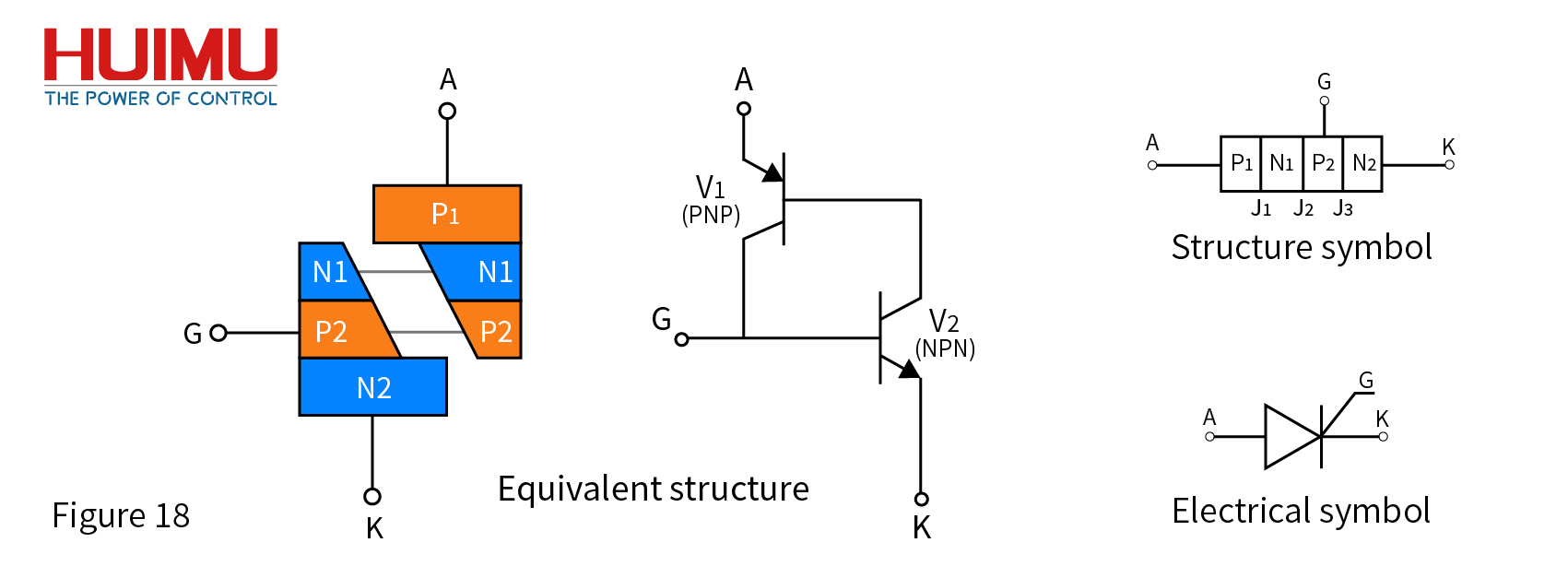
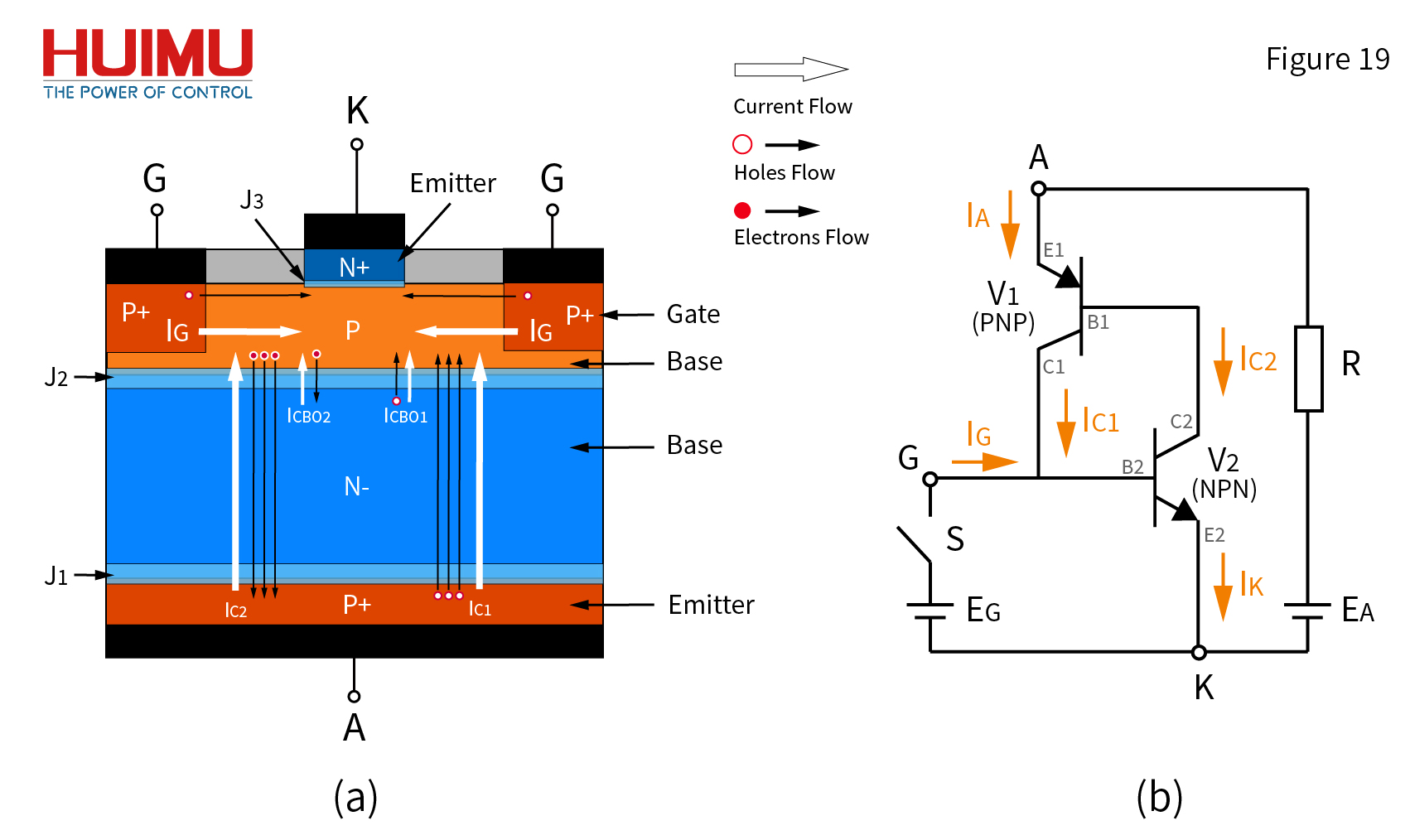
The thyristor has a P-N-P-N four-layer structure, which has one more PN junction than transistor. The thyristor has three terminals -- anode A, cathode K, and gate G. The doping degree of the P-type semiconductor and the N-type semiconductor of the thyristor are different. The internal structure of the thyristor can be equivalent to two transistors V1 and V2, as shown in Figure 19, a. V1 is a PNP transistor (P+|N-|P). P+ region is the emitter region, N- region is the base region, and P region is the collector region. V2 is an NPN transistor (N+|P|N-). N+ region is the emitter region, P region is the base region, and N- region is collector region. Similar to the transistor, when using a thyristor, be careful not to connect the cathode and anode reversely to prevent the thyristor from being burned.

4.2.2 Working Principle of Thyristors

The equivalent working circuit of the thyristor is shown in Figure 19, b. V1 and V2 are equivalent transistors. The anode and cathode of the thyristor are connected to the output circuit, and the gate of the thyristor is connected to the input circuit. EA is the power supply in the output circuit, and EG is the power supply in the input circuit. R is the output resistance. IC1 is the collector current of V1, and IC2 is the collector current of V2. The current flowing through the anode is anode current IA, the current flowing through the cathode is cathode current IK, and the current flowing through the gate is gate current IG. α1 is the common base current gain of V1, and α2 is the common base current gain of V2. The idea of turning on the thyristor is similar to that of the transistor, that is, how to make the PN junction J2 generate a larger reverse current.

Cut-off State: When a forward bias voltage UAK is applied to the cathode and anode of the thyristor, and no voltage is applied to the gate, it is equivalent to that the collector and the base of V1 and V2 are open, and the thyristor is in the off state. Due to the effect of the forward bias voltage, the depletion layer of J1 and J3 becomes narrower, and the depletion layer of J2 becomes wider, so there is a reverse saturation current ICBO in J2 -- This current consists of two parts, one is the hole current ICBO1 (the common base current of V1), and the other is the free electron current ICBO2 (the common base current of V2). These two currents will flow through J1 and J3, forming the leakage current of the thyristor, which is slightly larger than the sum of the leakage currents of the two equivalent transistors. It should be noted that in the positive blocking state, α1 + α2 is very small.

Conduction State: When a forward bias is applied to the gate of the thyristor, the P+ region injects a large number of holes into the P base region -- one part of it enters the N+ region, making J3 forward conduction, and a large number of free electrons are injected into the P base region from the N + region, and the minority carrier concentration in the P base region increases, making ICBO2 increase; the other part of it enters the N- region, making the minority carrier concentration in the N- region increase, so ICBO1 increases. Both of these leakage currents will reduce the minority carriers in the N- region and narrow the depletion layer of J1. When a sufficiently large gate forward bias is given to make the depletion layer of J1 narrow to a certain extent, the dynamic balance of J1 is broken, and a large number of holes are injected into the N- region from the P+ region, which flows into the P region in the form of a reverse current and forms the current IC1, and then flows out of the thyristor from the N+ region in the form of a forward current; similarly, the free electrons in the N+ region flow from the P region to the P+ region, and form the current IC2. It should be noted that when IC1 and IC2 are not established, the base conductivity is very small, so α1 + α2 is very small. However, when IC1 and IC2 are established, due to the conductance modulation effect, the conductivity of the base region of V1 and V2 increases, which leads to the increase of IC1 and IC2. The positive feedback between these two currents makes α1 + α2 increase rapidly and approach 1, making the on-state voltage drop sharply drops, and the anode current IA sharply rises, and finally turning on the thyristor.

* Calculation Formula of Thyristor

IC1 = α1 * IA + ICBO1(10)

IC2 = α2 * IK + ICBO2(11)

IK = IA + IG(12)

IA = IC1 + IC2(13)

IA = (α2 * IG + ICBO1 + ICBO2) /[1 - (α1 + α2) ]. (14)

It can be seen from Formula 14:

When α12 approaches 0, IA will tend to leak current;

When α12 approaches 1, IA will tend to infinity.

4.3 Main Parameters of Thyristors

4.3.1 Static Parameters (Voltage)

1- Forward Non-repetitive Peak Voltage UDSM / Reverse Non-repetitive Peak Voltage URSM

When the gate is open, the forward non-repetitive peak voltage UDSM (also known as the maximum off-state transient voltage) is the off-state peak voltage determined by the sharp bending point of the forward volt-ampere characteristic curve; the reverse non-repetitive peak voltage URSM (also known as the maximum reverse transient voltage) is the off-state peak voltage determined by the sharp bending point of the reverse volt-ampere characteristic curve.

2- Forward Turning Voltage UBO

The forward turning voltage UBO refers to the peak voltage that causes the thyristor to transit from the off state to the on state when a forward sin half-wave voltage is applied between the anode and the cathode of the thyristor and the gate is open at the rated junction temperature (100℃).

3- Reverse Breakdown Voltage UBR

The reverse breakdown voltage UBR refers to the peak voltage that causes the reverse leakage current of the thyristor to increase sharply when a reverse sine half-wave voltage is applied between the anode and the cathode of the thyristor at the rated junction temperature (100℃).

4- Forward Off-state Repetitive Peak Voltage UDRM / Reverse Off-state Repetitive Peak Voltage URRM

The forward off-state repetitive peak voltage UDRM (also known as the off-state repetitive peak voltage) is the forward peak voltage allowed to be repeatedly applied to the device when the gate is open and the junction temperature is rated. The repetition rate is 50 times per second, and the duration of each time is not more than 10ms. Generally, UDRM is specified as 90% of UDSM. And UDRM should be 100V smaller than UBO.

The reverse off-state repetitive peak voltage URRM (also known as the reverse repetitive peak voltage) is the reverse peak voltage allowed to be repeatedly applied to the device when the gate is open and the junction temperature is rated. The repetition rate is 50 times per second, and the duration of each time is not more than 10ms. Generally, URRM is specified as 90% of URSM. URRM voltage should be lower than UBR.

UDRM and URRM will decrease with the increase of temperature. During testing and use, the temperature should be strictly regulated. Usually, the smaller one of UDRM and URRM is taken as the rated voltage of the thyristor.

5- Gate Trigger Voltage UGT

The gate trigger voltage UGT refers to the minimum gate DC voltage required to transit the thyristor from the off state to the on state when a certain value of forward voltage is applied between the anode and the cathode of the thyristor under the specified ambient temperature. UGT is generally about 1.5V.

6- Forward Average Voltage Drop UF

The forward average voltage drop UF (also known as on-state average voltage or on-state voltage drop) refers to the average value of the voltage drop between the anode and the cathode of the thyristor when the on-state current of the thyristor is the rated current under the specified ambient temperature and standard heat dissipation conditions. UF is usually 0.4-1.2V.

7- On-State Peak Voltage UT

The on-state peak voltage UT refers to the transient peak voltage when the on-state current of the thyristor is a specified multiple of the rated current.

4.3.2 Static Parameters (Current)

1- Rated On-state Current IT

The rated on-state current IT refers to the maximum power frequency sine half-wave current value allowed to flow through the thyristor under the condition of the specified ambient temperature (40°C) and the specified cooling conditions, when the conduction angle is not less than 170°, the load is resistive, and the stable junction temperature does not exceed the rated junction temperature. The unidirectional thyristor uses the rated on-state average current IT(AV) as the rated current; the bidirectional thyristor uses the rated on-state effective current IT(RMS) as the rated current. If the current waveform is not a power frequency sine half-wave, although the thyristor is a semiconductor without the same volt-ampere characteristic curve as the resistance, a resistor with the same effective value (same heating effect) can be used as the reference to determine the rated current of the thyristor (1.5-2 times the equivalent calculation result of the resistance).

2- Off-state Leakage Current IDRM / Reverse Leakage Current IRRM

IDRM and IRRM are the corresponding leakage currents of UDRM and URRM respectively, generally less than 100μA.

3- Gate Trigger Current IGT

The gate trigger current IGT refers to the minimum gate DC current required to transit the thyristor from the off state to the on state when a certain value of forward voltage is applied between the anode and the cathode of the thyristor under the specified ambient temperature. The IGT of ordinary thyristor is generally several milliamperes; the IGT of high-sensitivity thyristors is generally several micro-amperes.

4- Holding current IH

The holding current IH is the minimum current required to keep the thyristor conducting. The IH is generally tens to hundreds of milliamperes. When the gate is triggered, even if the gate signal is removed, the thyristor is still on, and the thyristor can only be turned off by reducing the anode current. When the anode current is less than IH, the thyristor will be turned off. The higher the junction temperature, the smaller the IH, the less likely the thyristor is to be turned off.

5- Latching current IL

The latching current IL refers to the minimum current required to keep the thyristor turned on after the thyristor has just turned from the off state to the on state and the gate signal is removed. For the same thyristor, IL is generally about 2-4 times of IH.

6- Inrush Current ITSM

The inrush current ITSM refers to the non-repetitive maximum forward overload current when the junction temperature of the thyristor caused by the abnormal circuit exceeds the rated junction temperature during the half cycle of the power frequency sine wave. Normally, in a forward wave, the thyristor can withstand an overload current that is 6 times the rated current. During the life of the thyristor, if the limit of the number of surges is exceeded, the thyristor may be permanently damaged.

7- Forward Turning Current IBO

The forward turning current IBO refers to the peak current that can change the thyristor from the off state to the on state when the gate is open at the rated junction temperature (100℃).

4.3.3 Dynamic Parameters

1- Turn-on time tgt

The turn-on time tgt refers to the delay time for the thyristor to switch from the off state to the on state when enough trigger signals are applied. During the turn-on process, the output voltage UAK of the thyristor will gradually decrease to the on-state voltage drop UF, and the anode current IA will gradually increase to the rated on-state current IT.

2- Turn-off time tq

The turn-off time tq refers to the time interval from when the on-state current of the thyristor drops to zero until the thyristor begins to withstand the specified off-state voltage. The tq of an ordinary thyristor is about several hundred milliseconds. The tq is not only related to the internal structure of the tube, but also related to the temperature, dv/dt, di/dt and etc. The tq can usually be reduced by increasing the reverse voltage. If the anode voltage is reapplied during the tq, the thyristor can be turned on again, but once the tq has passed, the thyristor will be turned off no matter how to increase the anode voltage (provided that the thyristor is not broken down).

The tgt and the tq determine the operating frequency of the thyristor. For high operating frequency circuits, a thyristor with a small tq should be selected (if tq is small, tgt will be smaller). This parameter is the main difference between ordinary thyristors and fast thyristors.

3- Critical Off-state Voltage Rise Rate dv/dt

The critical off-state voltage rise rate dv/dt refers to the maximum rise rate of the applied voltage of the thyristor from off-state to on-state conversion when the gate is open at the rated junction temperature. When the junction capacitor charging current is large, if the voltage rise rate is too large, the charging current will become large enough to cause the thyristor to turn on by mistake. The dv/dt of a small current thyristor (50-100A) is generally 225V/μs, and the dv/dt of a large current thyristor (above 200A) is generally greater than 50V/μs.

4- Critical On-state Current Rise Rate di/dt

The critical on-state current rise rate di/dt refers to the maximum rise rate of the on-state current that the thyristor can withstand without damage when the gate is close at the rated junction temperature. The thyristor will produce a large power loss at the moment of turning on, and due to the limited conduction expansion speed, this loss is always concentrated in the cathode region near the gate. If the current rises too fast, even if the conducting current is not large, it will easily cause the thyristor to overheat locally, causing permanent damage to the gate, and causing the thyristor to be burned out. The larger the rated current of the thyristor, the more prominent this problem.

4.4 Basic Characteristics of Thyristors

4.4.1 Static Characteristics of Thyristors
Static Characteristics of Thyristors

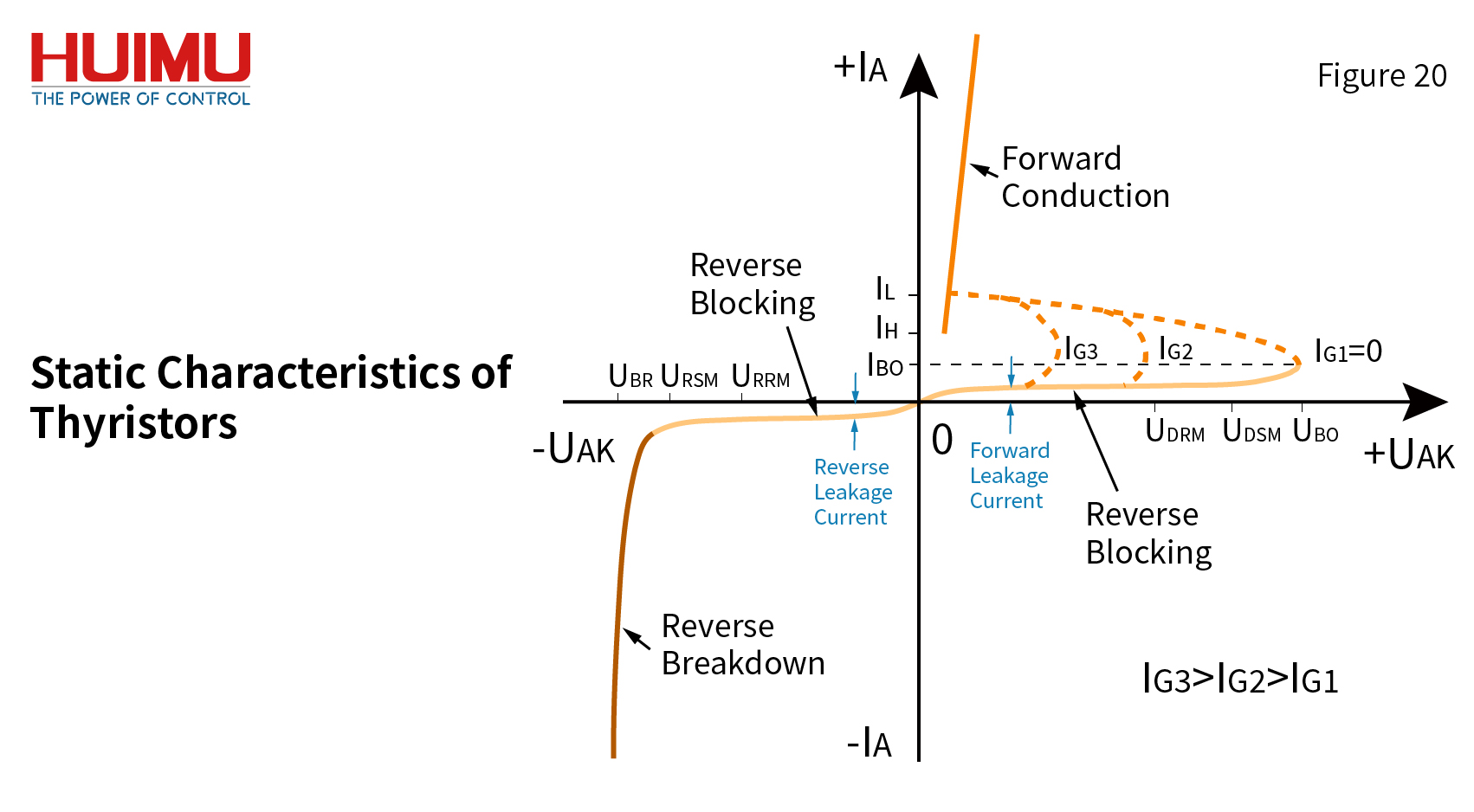
The static characteristics of the thyristor are the volt-ampere characteristics of the output current and output voltage, as shown in Figure 20. UAK is the voltage applied to the anode and the cathode of the thyristor, IA is the anode current, and IG is the trigger current.

1- Forward static characteristics

Forward Blocking State: When IG = 0, even if UAK> 0, there is only a small forward leakage current. α1 + α2 is also very small. At this time, the thyristor is in the forward blocking state. But when UAK ≥ UBO or IA ≥ IBO, α1 + α2 approaches 1, and the thyristor will enter the forward conduction state.

Forward Conduction State: The common forward conduction situation is that under the condition of IG> 0, when UAK ≥ UGT, the conductivity of the thyristor base area increases significantly, α1 + α2 approaches 1, the current IA flowing through the thyristor will approach infinity (the actual value of IA is determined by the external circuit), and finally saturated conduction is achieved. Under the same external conditions, the larger IG, the smaller UGT. It should be noted that once the thyristor is turned on, the gate loses its control function. Only when the output current IA of the thyristor is reduced to a certain value close to 0 can the thyristor be turned off.

2- Reverse Static Characteristics

The reverse static characteristics of thyristors are similar to the reverse static characteristics of power diodes. When the thyristor is subjected to a reverse voltage, no matter whether the gate has a trigger current or not, the thyristor will not be turned on, and there is only a very small reverse leakage current. At this time, the thyristor is in a reverse blocking state. However, when the reverse voltage reaches the reverse breakdown voltage UBR, it will cause the thyristor avalanche breakdown.

4.4.2 Dynamic Characteristics of Thyristors
Dynamic Characteristics of Thyristors

1- Turn-on Process

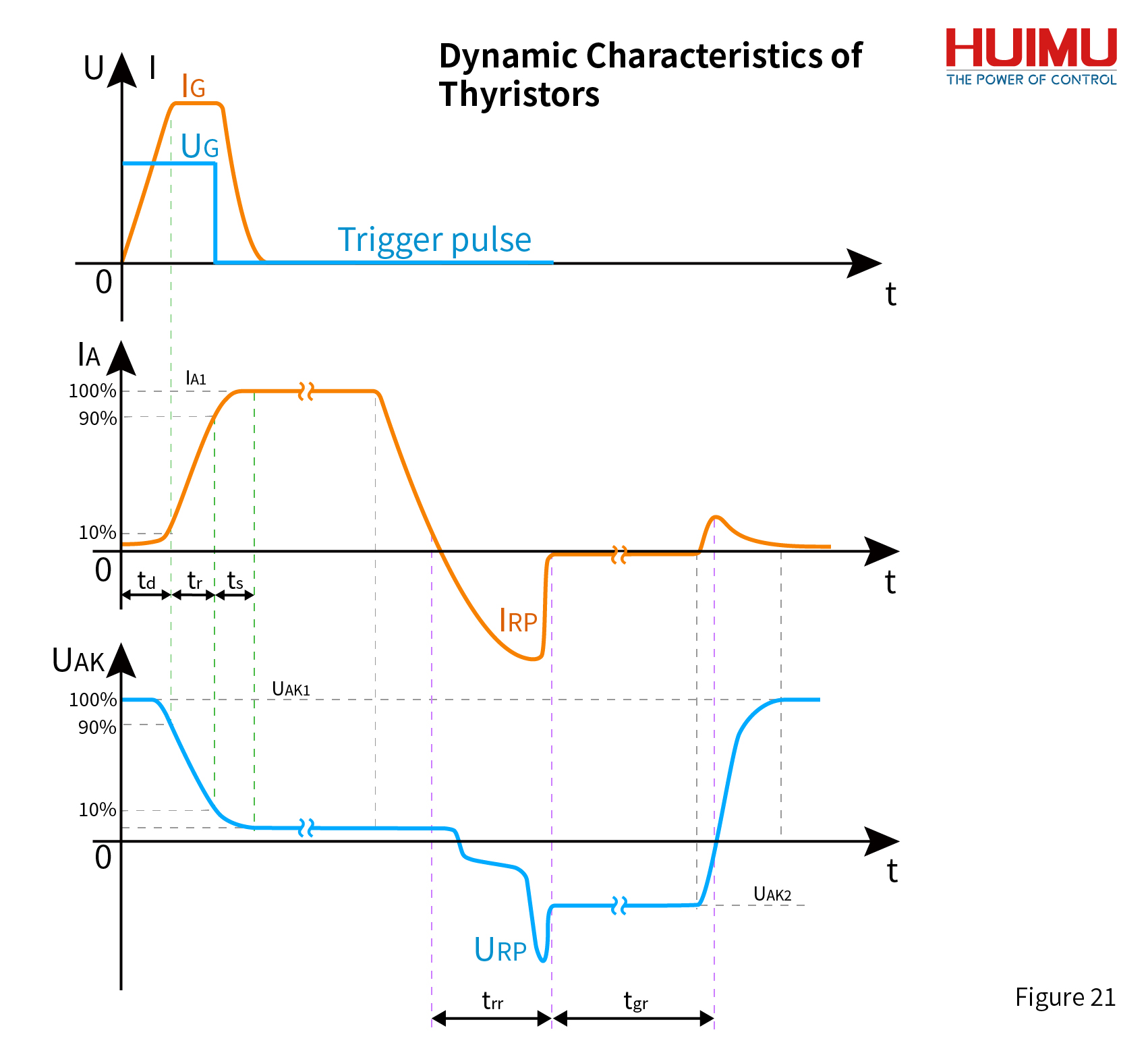
When UAK1 is applied to the output terminal of the thyristor, the thyristor is in the off state at this time, and UAK is 100% UAK1. When UG ≥ UGT, it will take a period of time before the thyristor enters the conducting state. When the thyristor is turned on, its output terminal voltage UAK will maintain a very small value, that is, the on-state voltage drop.

The turn-on process of the thyristor is divided into the delay time td, the rise time tr, and the diffusion time ts.

The delay time td is the time required for IA to rise from the forward leakage current to 10% IA1, and UAK to decrease from 100% UAK1 to 90% UAK1. The delay time is generally 0.5-1.5μs. The delay time decreases as the gate current increases.

The rise time tr is the time required for IA to rise from 10% IA1 to 90% IA1, and UAK to fall from 90% UAK1 to 10% UAK1. The rise time is affected by the characteristics of the thyristor itself, the impedance of the external circuit, the temperature, the anode voltage and etc. The rise time is generally 0.5-3μs. By increasing IA, the delay time td and the rise time tr can be significantly shortened.

The diffusion time ts is the time required for IA to rise from 90% IA1 to 100% IA1, and UAK to drop from 10% UAK1 to the on-state voltage drop. The diffusion time depends on the cross-sectional area of the cathode.

Normally, when IA reaches 90% IA1, it can be considered that the thyristor has been turned on. Therefore, the formula for calculating the turn-on time is: tgt = td + tr.

2- Turn-off Process

By reducing UAK to 0 or applying a sufficiently large reverse voltage UAK2, IA is gradually reduced, and the thyristor is converted from the on state to the off state. The turn-off process of the thyristor is divided into the reverse blocking recovery time trr, and the forward blocking recovery time tgr.

During the turn-off process, due to the inductance of the external circuit, a reverse recovery current IR appears in the thyristor. When the IR gradually reaches the peak value IRP, a corresponding URP will be generated, and then the IR will rapidly decay. The time from IA falling to zero to IR falling to the reverse leakage current of the thyristor is called the reverse blocking recovery time trr.

The time from the end of the reverse recovery process to the complete recovery of the forward blocking capability of the thyristor is called the forward blocking recovery time tgr (or gate recovery time). During the tgr, because a small number of carriers are left on the PN junction near the gate, they can still trigger the positive feedback mechanism inside the thyristor. If a forward voltage is applied to the thyristor, the thyristor will conduct forward again. No gate trigger signal is required during this turn-on process.

The calculation formula of the turn-off time tq is: tq = trr + tgr.

4.5 Series and Parallel Connection of Thyristors

1- Series Connection of Thyristors

By connecting multiple thyristors in series, the overall voltage capacity can be increased. In fact, it is not possible to multiply the withstand voltage value of a thyristor by the number to obtain the overall withstand voltage value. Instead, it should be added by the voltage actually borne by each thyristor. This is mainly because the voltage distributed on each thyristor is not uniform (divided into static uneven voltage and dynamic uneven voltage).

Static Uneven Voltage: Although the leakage current flowing through the series-connected thyristors is the same, because of their dispersion of static volt-ampere characteristics, the voltages assigned to each thyristor are not the same. In extreme cases, a certain thyristor may withstand all voltages, while other thyristors may only withstand very small voltages. The static uneven voltage can be reduced by selecting thyristors with very similar parameters and characteristics. The resistance equalization method can also be used to reduce static unevenness, that is, the thyristor is regarded as a high-resistance resistor (about 1 megohm), and each thyristor is connected in parallel with a low-resistance resistor to adjust the equivalence resistor of each parallel circuit. when their equivalent resistance values are very close, then the voltage distributed on each thyristor will also be very close.

Dynamic Uneven Voltage: The dynamic uneven voltage is caused by the difference in dynamic parameters and dynamic characteristics of the thyristor. By selecting thyristors whose dynamic parameters and characteristics are as consistent as possible, the dynamic uneven voltage can be reduced. It can also be triggered by a strong gate pulse to significantly reduce the difference in the turn-on time of the thyristor. It is also possible to use RC parallel branches for dynamic voltage equalization, that is, to absorb the over-voltage through the RC circuit, so that the voltage that each thyristor bears under dynamic conditions is very close.

2- Parallel Connection of Thyristors

By connecting multiple thyristors in parallel, the overall current capacity can be increased. Because of the different parameters and characteristics of each thyristor, it is also necessary to consider their uneven current distribution. By selecting thyristors with consistent characteristics and parameters as much as possible to reduce the dynamic uneven current and the static uneven current. It is also possible to reduce the dynamic uneven current by the current-sharing reactor (its loss is less than resistance). It is also possible to use strong gate pulse triggering to significantly reduce the difference in the turn-on time of the thyristors, so that each thyristor can be effectively triggered in a short time to achieve the purpose of dynamic current sharing. However, because the current capacity of the thyristor is getting larger and larger, it is usually unnecessary to operate the thyristor in parallel.

3- Series and Parallel Connection of Thyristors

When thyristors need to be connected in series and in parallel at the same time, it is usually recommended to connect in series firstly and in parallel secondly to ensure that the parameters and characteristics of each thyristor are as consistent as possible.

4.6 Main Types of Thyristors

1- Fast Switching Thyristor

The fast switching thyristor (FST) has excellent dynamic characteristics. Compared with ordinary thyristors, the FST has the advantages of short the turn-on time (generally 4-8μs), short turn-off time (generally 10-60μs), and large tolerance of dv/dt and di/dt. Ordinary thyristors can only work at a voltage of 50 Hz, while FST can work in circuits with higher frequencies (above 400 Hz). High-frequency thyristors (HFT) have shorter switching times and faster switching speeds than FST, and are suitable for working in high-frequency circuits (above 10kHz). Due to the high operating frequency, the heating effect of the switching loss of FST and HFT cannot be ignored, so their rated voltage and rated current are usually not high,

2- Bidirectional Triode Thyristor
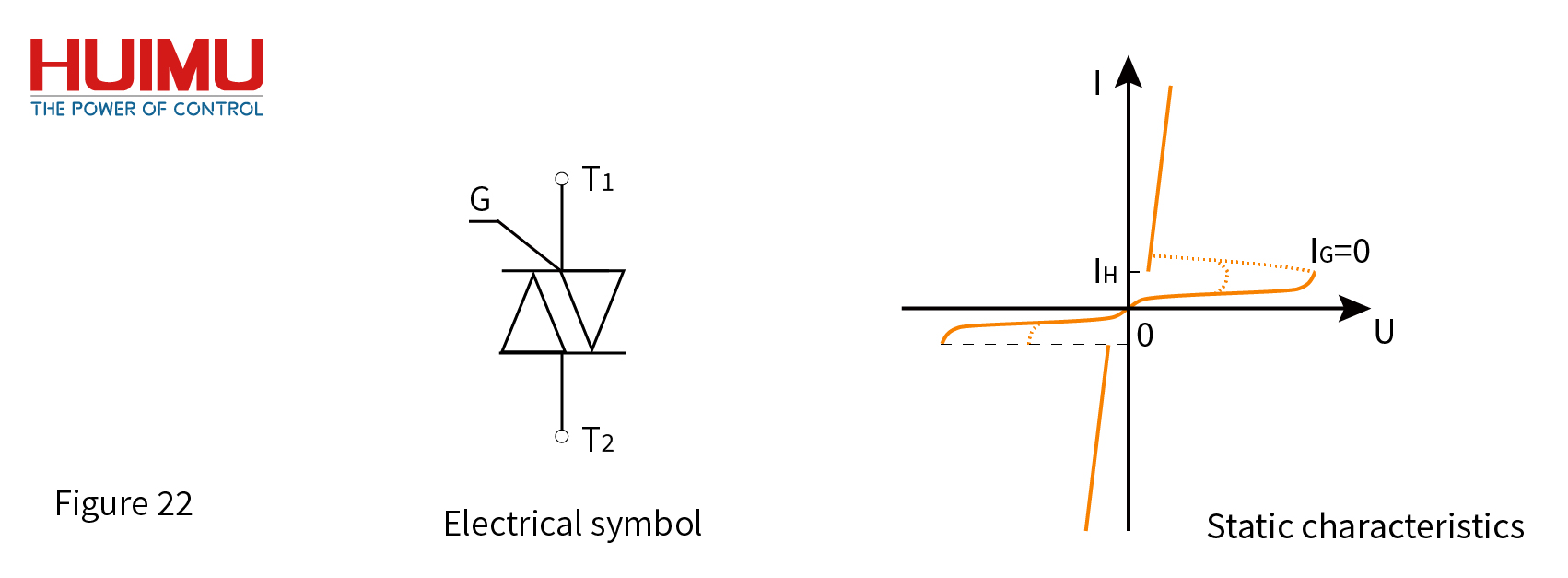
Bidirectional Triode Thyristor

The bidirectional thyristor (also known as bidirectional triode thyristor, triode AC switch, TRIAC) can be considered as a pair of anti-parallel connected unidirectional thyristors (SCR). The bidirectional thyristor is a common core device in AC solid-state relays and modules (click to view more AC solid-state relays). The forward characteristic of the bidirectional thyristor is the same as that of the unidirectional thyristor, but its reverse characteristic is different from that of the unidirectional thyristor. The bidirectional thyristor does not have the reverse blocking ability. It can be clearly seen on the coordinate axis that the characteristic curve of the bidirectional thyristor is centrally symmetric. The bidirectional thyristor has a T1 pole (the main electrode connected to the P-type semiconductor material), a T2 pole (the main electrode connected to the N-type semiconductor material), and a gate G pole. The rated current of the bidirectional thyristor is the rated on-state effective current IT(RMS). There is no forward peak voltage and reverse peak voltage in the parameters of the bidirectional thyristor, but only the maximum peak voltage. The other parameters of the bidirectional thyristor are the same as the unidirectional thyristor.

3- Reverse Conducting Thyristor
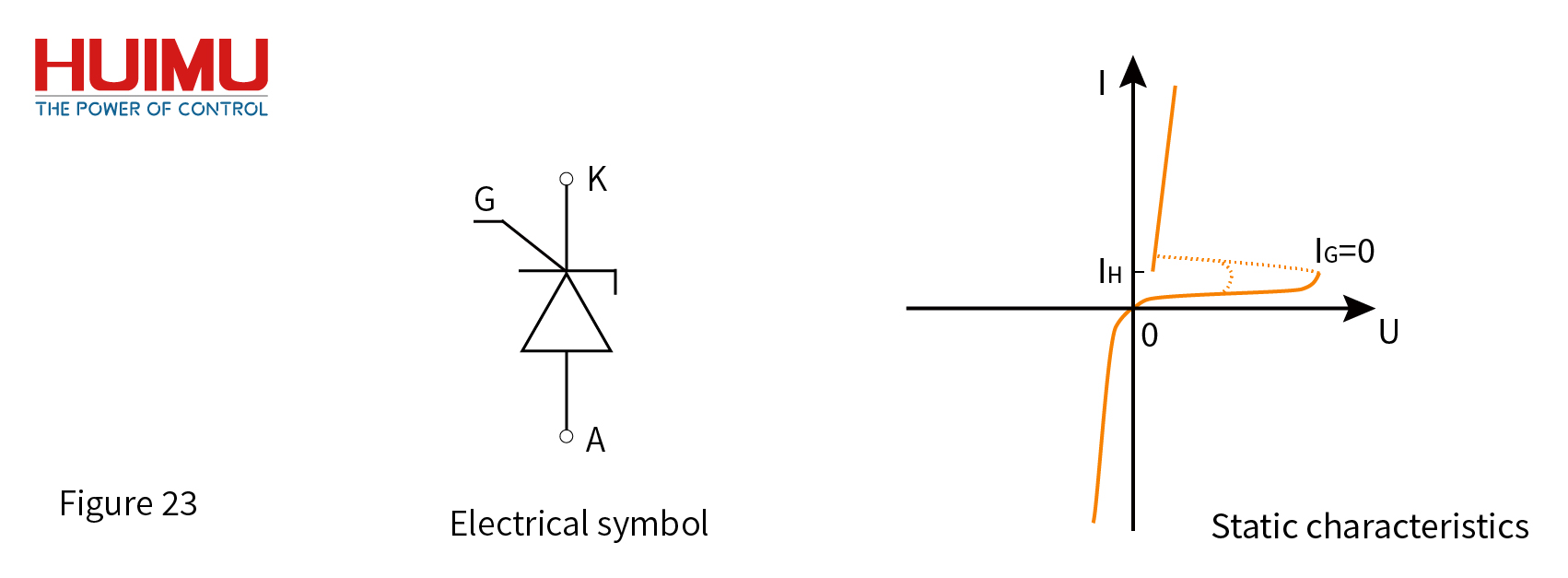
Reverse Conducting Thyristor

The design idea of the reverse conducting thyristor (RCT) is similar to that of the bidirectional thyristor, but the reverse conducting thyristor uses a power diode for anti-parallel connection, so that the emitter junction of the anode and the cathode are both in the short-circuit state. Due to this special structure, the reverse conducting thyristor has the advantages of low on-state voltage, short turn-off time, high rated junction temperature, high voltage resistance, high temperature resistance, and etc. For example, the turn-off time (several microseconds) and power frequency (tens of kHz) of the reverse conducting thyristor are obviously better than that of the fast switch thyristor. Reverse conducting thyristor can be regarded as an organic combination of thyristor and freewheeling power diode, which can simplify circuit design, and is widely used in applications such as switching power supplies and UPS.

4- Light Triggered Thyristor
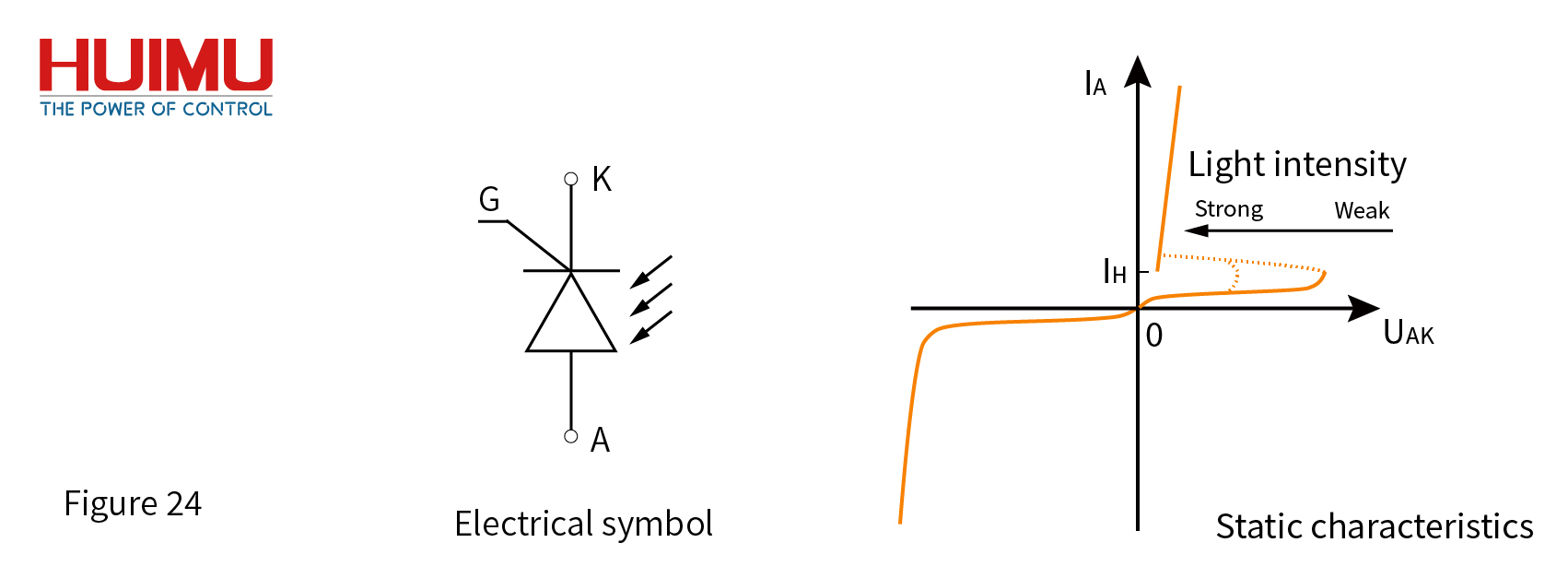
Light Triggered Thyristor

The light-triggered thyristor (also known as LTT, or light-controlled thyristor) is a thyristor that its gate region integrates a photoelectric power diode, and uses the strength of the light signal to replace the gate trigger current. Therefore, the light trigger is a kind of gate trigger. In order to improve the trigger sensitivity of the light-controlled thyristor, the gate region often adopts an amplified gate structure or a double-amplified gate structure. The light trigger ensures the electrical insulation between the main circuit and the control circuit, and can avoid the influence of electromagnetic interference. Low-power light-controlled thyristors are often used in electrical isolation to provide trigger signals for high-power thyristors. High-power light-controlled thyristors can ensure good insulation between the control circuit and the main circuit and are used in high-voltage power equipment (such as high-voltage direct current transmission).

An introduction to Power Electronic Devices - 3.What is a Transistor

§3. What is a Transistor?

Before introducing half-controlled devices and full-controlled devices, it is necessary to briefly introduce bipolar junction transistors (BJT).

3.1 Introduction to Transistors

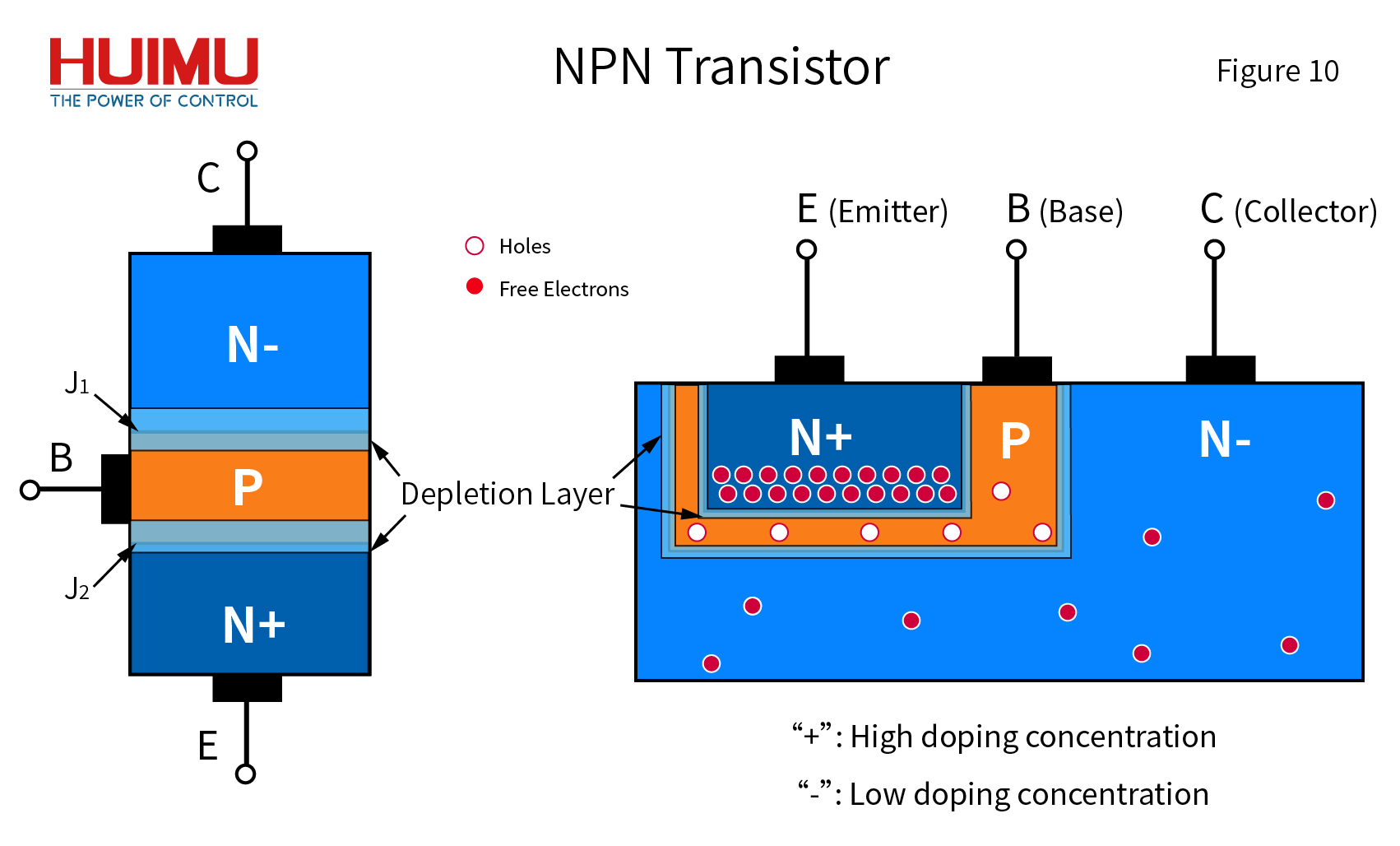
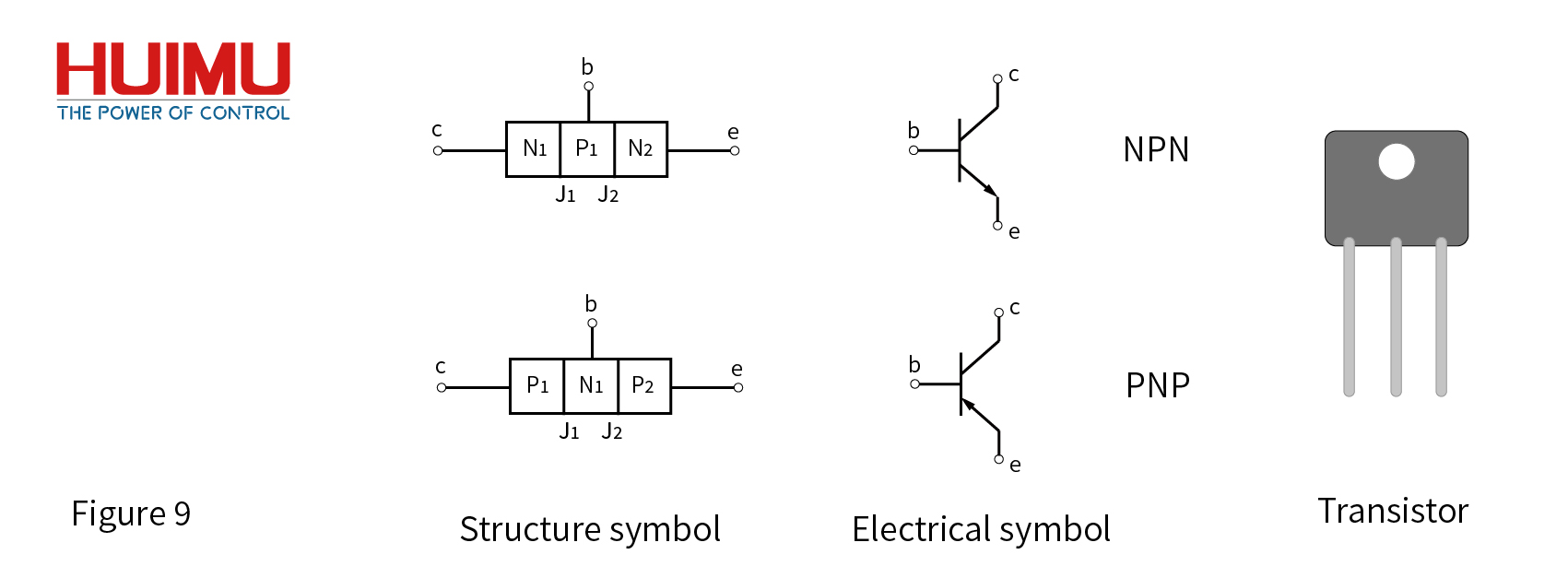
The structure and electrical symbol of transistor

The transistor (also known as semiconductor transistor or Bipolar Junction Transistor, BJT) is a bipolar device with three terminals and two PN junctions. The transistor is one of the basic components of semiconductor devices and also one of the core components. Since its birth in the 1940s, the transistor has completely changed the structure of electronic circuits, triggered a solid-state revolution, and promoted the emergence of integrated circuits and large-scale integrated circuits. The transistor has a current amplifying function, and can control a large change in collector current with a very small change in base current, so it is often used as a contact-less switch in electronic circuits. The switching frequency of the transistor is high, and there is no mechanical service life, so it has a significant advantage over electromagnetic relays and mechanical switches.

3.2 How does Transistor work?

3.2.1 Basic Structure of Transistors

Basic Structure of Transistors

The transistor is a three-layer semiconductor structure, which has one more PN junction than Power Diode. These two closely spaced PN junctions divide the transistor into three parts with different areas and doping concentrations -- the base region is very thin (3-30μm) and the doping concentration is low; the area of emitter region is small and the doping concentration is high; the area of collector region is large and the doping concentration is low. The PN junction between the collector region and the base region is called the collector junction J1. The PN junction between the emitter region and the base region is called the emitter junction J2.

According to the material, transistors can be divided into silicon transistors and germanium transistors. According to the doping composition, transistors can be divided into PNP transistors and NPN transistors -- under forward bias, the emitter region of PNP transistors emits holes, and its direction is the same as the direction of current, so the arrow in the electrical symbol goes from the emitter to the base; under forward bias, the emitter of the NPN transistors emits free electrons, and its direction is opposite to the direction of the current, so the arrow in the electrical symbol goes from the base to the emitter.

3.2.2 Working Principle of Transistors

Working Principle of Transistors

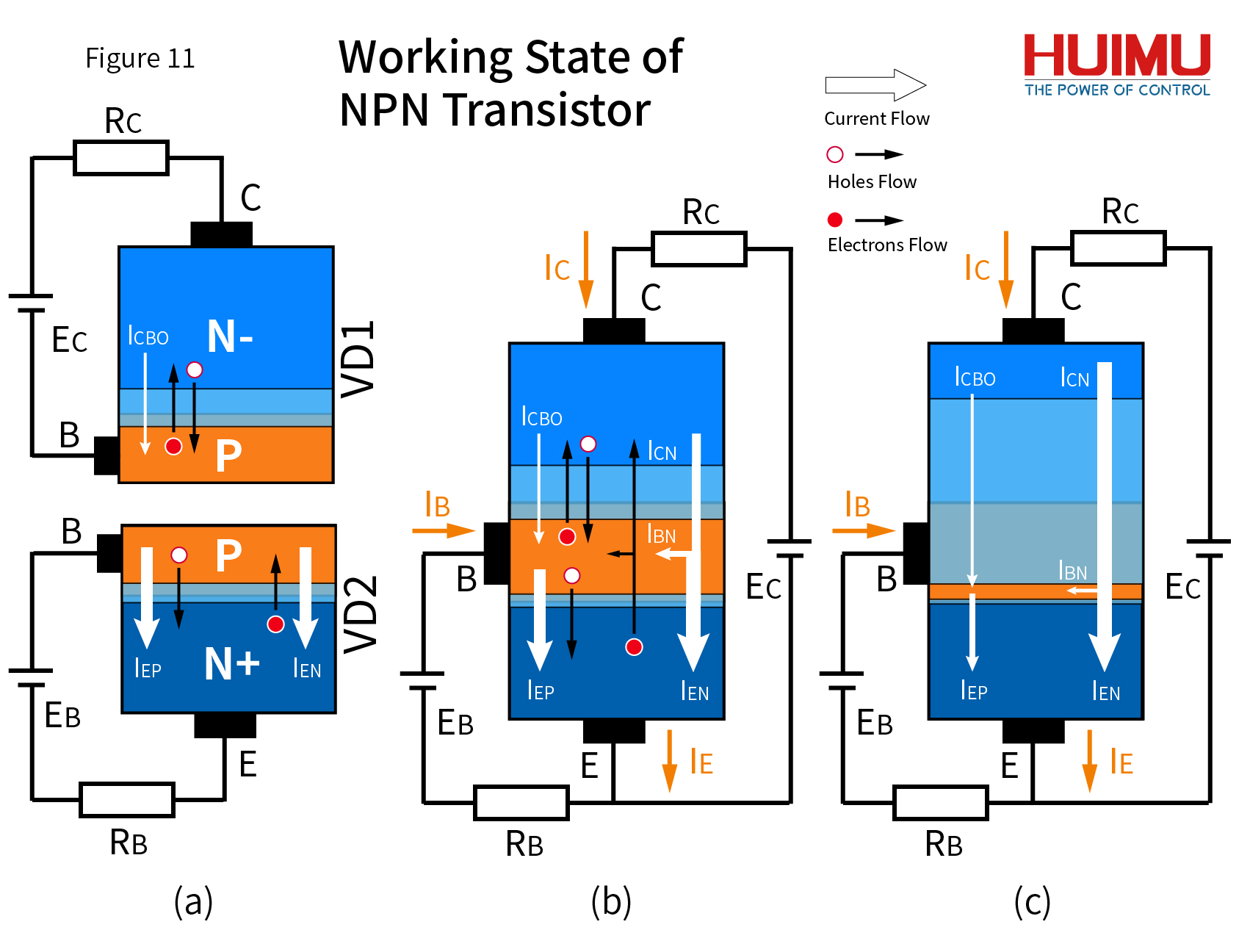
Take the NPN transistor as an example. The NPN transistor can be regarded as two equivalent diodes (VD1 and VD2), as shown in Figure 11, a. Because the N- region of VD1 has low a doping concentration and a large area, it is not prone to avalanche breakdown, so it can withstand a large reverse voltage. But in forward bias, the forward current of VD1 is very small, so VD1 is very suitable for working in reverse cut-off state. VD1 will produce a reverse saturation current ICBO when VD1 works in the reverse state, but the doping concentration of N- region and P region is very low, so the ICBO is very small. Because the N+ region of VD2 has a high doping concentration and a small area, it is prone to avalanche breakdown, so its reverse withstand voltage capability is very poor. But in forward bias, VD1 can generate a very large forward current, so VD2 is very suitable for working in the forward conduction state. When VD2 works in the forward state, it will generate two currents, one is the current IEP generated by the holes flow of the P region, and the other is the current IEN generated by the electrons flow of the N+ region. Since the doping concentration of the P region of VD1 is lower than that of the N+ region, IEN is greater than IEP. When we know the working principle of these two equivalent diodes, it is easy to understand the working principle of the NPN transistor.

Connect the NPN transistor through the common emitter connection method -- a collector power supply EC and collector resistance RC are connected in series to the collector and the emitter; a base power supply EB and a base resistance RB are connected in series to the base and the emitter. In this circuit, current flows into the NPN transistor from the collector and base, and flows out of the NPN transistor from the emitter -- the total current flowing in from the collector is the collector current IC; the total current flowing in from the base is the base current IB; the total current flowing out from the emitter is the emitter current IE. The linear relationship between IC and IE is common base current gain α, and the linear relationship between IC and IB is common emitter current gain β. It is worth noting that due to the difference in doping concentration, the collector junction J1 is not suitable for forward bias, and the emitter junction J2 is not suitable for reverse bias. If the collector and emitter are reversely connected, the possibility of NPN transistor breakdown will increase significantly.

Cut-off State: The structure of NPN makes there is always a PN junction in a reverse bias state. When no voltage is applied to the base, even if a large voltage (less than breakdown voltage BVCEO) is applied to the collector and the emitter, the NPN transistor cannot be turned on (but there is a small leakage current ICEO).

Active State: VD1 and VD2 must work at the same time to turn on the NPN transistor, so a certain voltage needs to be applied to the base to make J1 reverse biased (UBC<0) and J2 forward biased (UBE> UTO). When the NPN transistor is turned on, its internal current is a bit different from when the equivalent diodes worked separately, as shown in Figure 11, b. The free electrons injected from the N+ region into the P region do not completely recombine with the holes in the P region. Due to the reverse bias of J2, a part of the free electrons will pass through the P region and be directly injected into the N- region, and generate a reverse current ICN. When the NPN transistor is working in an active state, a small change in the base current IB of will cause a large change in the collector current IC. This phenomenon is called conductance modulation effect. This phenomenon is like a tiny input current being amplified into a huge output current, so the active state is also known as the amplification state.

Saturation State: With the increase of IB, the concentration of holes in the P region decreases, IEP decreases, and the depletion region of J1 keeps increasing. At the same time, since the free electrons injected from the N+ region into the P region are getting less and less, IBN has dropped to near the minimum value, and the amplification effect of IB on IC has begun to weaken. When IB and IC no longer have a linear relationship, the NPN transistor begins to enter a saturated state. At this time, as IB increases, IC slowly increases, and the saturation depth of the NPN transistor also begins to deepen. When almost all the free electrons in the N+ region are injected into the N- region, the base potential is the same as the collector potential (UBC=0). At this time, the NPN transistor is in a deep saturation state, and IC is completely unaffected by IB. It should be noted that as the depletion region of J1 increases, the possibility of avalanche breakdown on J1 also increases.

* Calculation Formula of Transistor

IC = ICN + ICBO(1)

IB = IBN + IEP - ICBO(2)

IE = IC + IB = ICN + IBN + IEP(3)

because IC > 0, then we get IE / IC = IB / IC + 1; (4)

α = ICN / IE = (IC - ICBO) / IE(5)

β = ICN / (IB + ICBO) = (IC - ICBO) / (IB + ICBO), (6)

because IC > IB >> ICEO >> ICBO ≈ 0, if ignoring all the leakage current, we can get α ≈ IC / IE, β ≈ IC / IB(7)

then we can get 1/α = 1/β + 1, (8)

so the relation between α and β is: α = β / (1 + β), β = α / (1 - α). (9)

* Leakage Current

Leakage Current of NPN Transistor

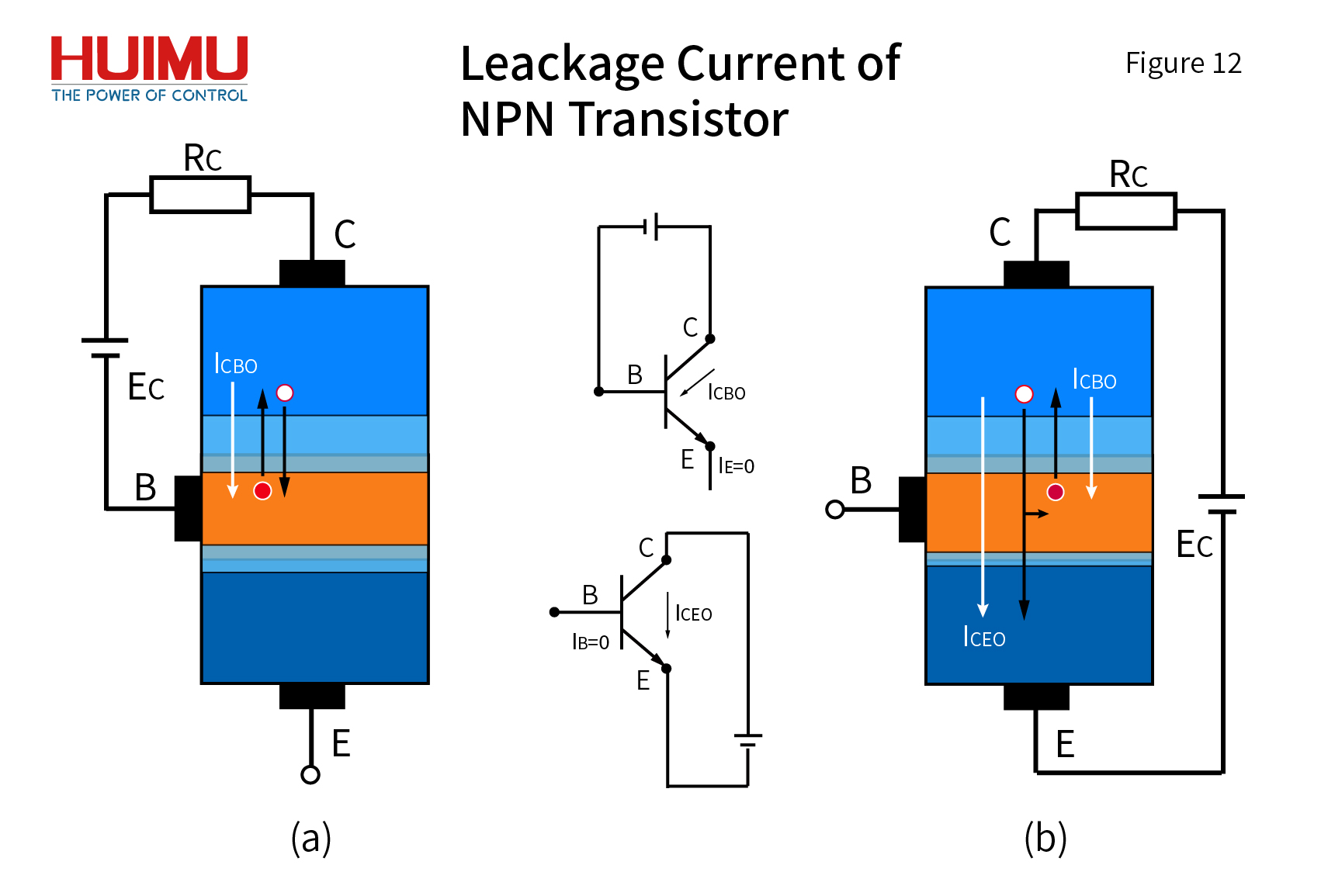
Both the collector junction reverse saturation current ICBO and the penetration current ICEO are unavoidable leakage currents in the transistor. By opening the emitter of the transistor (IE=0) and applying voltage to the collector and the base, the value of ICBO can be measured, as shown in Figure 12, a. By opening the base of the transistor (IB=0) and applying voltage to the collector and the emitter, the value of ICEO can be measured, as shown in Figure 12, b.

The generation mechanism of the collector junction reverse saturation current ICBO is shown in Figure 11, a.

The generation mechanism of the penetration current ICEO is as follows: Under the action of an external electric field, the majority carriers in the collector region move away from the PN junction, widening the space charge region, and the built-in electric field of the collector junction J1 is enhanced, which is conducive to drift motion; the majority carriers in the emitter region move closer to the PN junction, narrowing the space charge region, and the built-in electric field of the emitter junction J2 is weakened, which is not conducive to drift motion. Therefore, under the action of the built-in electric field, the minority carriers in the base region drift to the collector region through J1. At the same time, the minority carriers in the collector region drift to the base region through J1, part of which participates in the recombination of the base region, and the other part diffuses to the emitter region through J2. Due to the low doping concentration of the base region, the proportion of minority carriers participating in the recombination of the base region is very low. It is not difficult to find that this process is very similar to the generation mechanism of IEN when the transistor is turned on. Therefore, there is a linear relationship between ICEO and ICBO, ICEO = (1 + β) * ICBO. However, due to the low doping concentration of the collector region and the base region, the value of ICEO is very low and can usually be ignored. The ICEO of silicon transistors is generally less than 100nA; the ICEO of germanium transistors is generally less than 100μA.

* Conductance Modulation Effect

Conductance (G) is the reciprocal of resistance, and the unit is Siemens (S). Conductance modulation effect (also known as the base region conductivity modulation effect, or Webster effect) is one of the basic characteristics of bipolar transistors (BPT), which refers to the phenomenon that the conductivity of the base region increases significantly (or the resistivity of the base region decreases significantly) when the working current of the bipolar transistor is large. Except BJT, other bipolar transistors such as SCR, GTO, GTR and parasitic transistors in IGBT all have conductivity modulation effect. In addition to the Webster effect, when the working current of the bipolar transistor is large, the Early effect (the phenomenon that the changes of the collector junction voltage will lead to the changes of the width of the base region) and the Kirk effect (the phenomenon that the width of the base region increases) will also appear.

3.3 Main Parameters of Transistors

1- Common Base Current Gain α

Common base current gain α (the full name is "hybrid parameter forward current gain, common base", HFB), which is determined by the emitter efficiency factor and the base region transport factor, α = FE * FB. When the base is zero-biased (UBC = 0), the base short-circuit amplification factor α0 is determined by the emitter efficiency factor, the base region transport factor, the collector efficiency factor and the avalanche multiplication factor, α0 = FE * FB * FC * M.

The emitter efficiency factor FE is the ratio of the electron current IEN injected into the base region to the emitter current IE, FE = IEN / IE = IEN / (IEN + IEP) = 1 / [1 + (IEP / IEN) ]. By reducing the doping concentration of the base region, the total amount of impurities in the base region is much smaller than the total amount of impurities in the emitter region, which can effectively increase the number of minority carriers injected into the base region from the emitter region. The closer the ratio of IEP to IEN is to 0, the higher the emission efficiency of the transistor.

The base region transport factor FB is the ratio of the electron current ICN that reaches the collector region to the electron current IEN injected into the base region, FB = ICN / IEN. By reducing the width of the base region, the time that carriers from the emitter region stay in the base region can be effectively shortened, thereby increasing the number of minority carriers that transit the base region. The smaller the width of the base region, the smaller the recombination loss of electrons from the emitter region in the base region.

The collector efficiency factor FC is the ratio of the collector current IC to the electron current ICN that reaches the collector region, FC=IC/ICN.

The avalanche multiplication factor M is used to describe the avalanche multiplication effect when the reverse voltage of the collector junction increases to close to the avalanche breakdown voltage. It is usually estimated with the following formula, M = 1 / [1 - (V / VB) ^n], n is determined by the material of the PN junction (silicon: n=1.5-4; germanium: n=2.5- 8); VB is the reverse breakdown voltage of the collector J1; V is the voltage across the collector junction. When the absolute value of V tends to the absolute value of VB, M tends to infinity, and avalanche breakdown will occur in the PN junction.

Generally, hFB(α) is used to express the common base DC current gain, hFB(α) = IC / IE, and its range is usually 0.95-0.99; hfb(α) is used to express the common base AC current gain, hfb(α) = ΔIC / ΔIE. In general, hfb(α) ≈ hFB(α).

2- Common Emitter Current Gain β

Common emitter current gain β (the full name is "hybrid parameter forward current gain, common emitter", HFE) is the ratio of collector current to base current, and its value is usually much larger than 1. Generally, hFE(β) is used to express the common emitter DC current gain, hFE(β) = IC / IB, which can be measured directly by a multimeter; hfe(β) is used to express the common emitter AC current gain, hfe(β) = ΔIC / ΔIB. The current amplification factor (or forward current gain) of the transistor usually refers to the common emitter current gain β.

3- Common Collector Current Gain γ

Common collector current gain γ (the full name is "hybrid parameter forward current gain, common collector", HFC) is the ratio of emitter current to base current. Generally, hFE(γ) is used to express the common collector DC current gain, hFC(γ) = IE / IB; hfc(γ) is used to express the common collector AC current gain, hfc(γ) = ΔIE / ΔIB. This parameter is rarely used in normal times.

4- Threshold Voltage UTO

The threshold voltage UTO is the voltage that triggers the conduction of the emitter junction of the transistor.

5- Characteristic Frequency fT

The characteristic frequency fT is also called the gain bandwidth product, which can be defined as the operating frequency of the transistor when β=1. If the operating frequency f0 and the high-frequency current amplification factor β are known, the characteristic frequency fT can be obtained, fT=β* f0. As the operating frequency increases, the magnification will decrease. If the operating frequency of the transistor is equal to the characteristic frequency (f0 = fT), the transistor completely loses the current amplification function; if the operating frequency of the transistor is greater than the characteristic frequency (f0> fT), the transistor will not work normally.

6- Maximum Operating Voltage UCEM

The maximum operating voltage UCEM is the rated voltage of the transistor. When the maximum operating voltage UCEM is exceeded, the transistor will be broken down.

7- Maximum Collector Allowable Current ICM

The maximum collector allowable current ICM is the rated current of the transistor. It is usually specified that the collector current IC corresponding to when the current gain β drops by half from the maximum value is ICM. In order to ensure the safety of use, it is generally necessary to leave a double margin.

8- Maximum Collector Dissipation Power PCM

The maximum collector dissipation power PCM is the power at which the transistor reaches the highest junction temperature under the highest operating temperature (usually 25°C). When the transistor reaches the maximum junction temperature, its internal PN junction structure will be permanently destroyed.

3.4 Basic Characteristics of Transistors

The relationship between the parameters of the transistor during stable operation (these parameters are usually fixed values or changing slowly) is called static characteristics. The relationship between the parameters of the transistor during the turn-on process and the turn-off process (these parameters are usually changing sharply) is called dynamic characteristics. If there is only a DC signal in the input signal of the transistor, it is called DC operation (or static operation). If there is an AC signal in the input signal of the transistor, it is called AC operation (or dynamic operation).

For the NPN transistor (common emitter connection), its input is the base and the output is the collector, so its input current is IB, the input voltage is UBE, and the output current is IC (output from the resistance RC in the output circuit), the output voltage is UCE.

3.4.1 Static Characteristics of Transistors

The static characteristics of the transistor are divided into input characteristics (relationship between input current and input voltage), output characteristics (relationship between output current and output voltage), temperature (the influence of temperature on input characteristics and output characteristics) and safe operating area (stable operating conditions of the transistor).

1- Input Characteristics

The input characteristic of the transistor

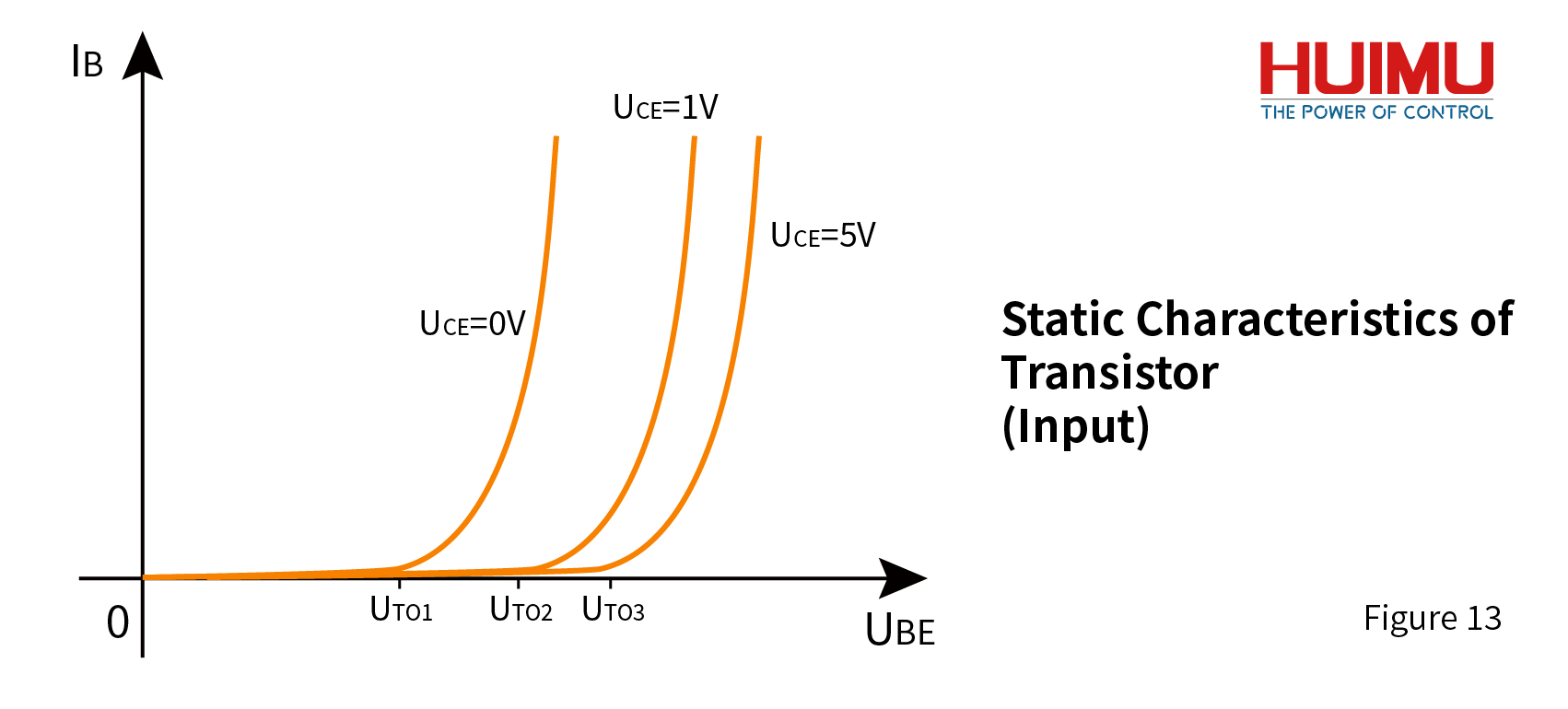
The input characteristic of the transistor is similar to the forward input characteristic of the power diode, as shown in Figure 13.

When UCE is fixed value and UBE>UTO, the base current IB increases with the increase of UBE.

When UCE increases, UTO increases and the input characteristics curve moves to the right. This is because with the increase of UCE, part of the carriers that should be injected into the base region from the emitter region pass through the base region and are directly injected to the collector region, so the carrier concentration in the base region is too low to open the emitter junction (that is, the diffusion current of the emitter junction is less than or equal to the drift current). Therefore, it is necessary to increase UBE to make more carriers be injected into the base region from the emitter region (that is, the threshold voltage increases), and the input characteristic curve also moves to the right. When UCE increases to a certain extent, most of the carriers that can be injected into the base region from the emitter region are collected to the collector region, so even if UCE continues to increase, the input characteristics of the transistor can hardly be changed.

2- Output Characteristics

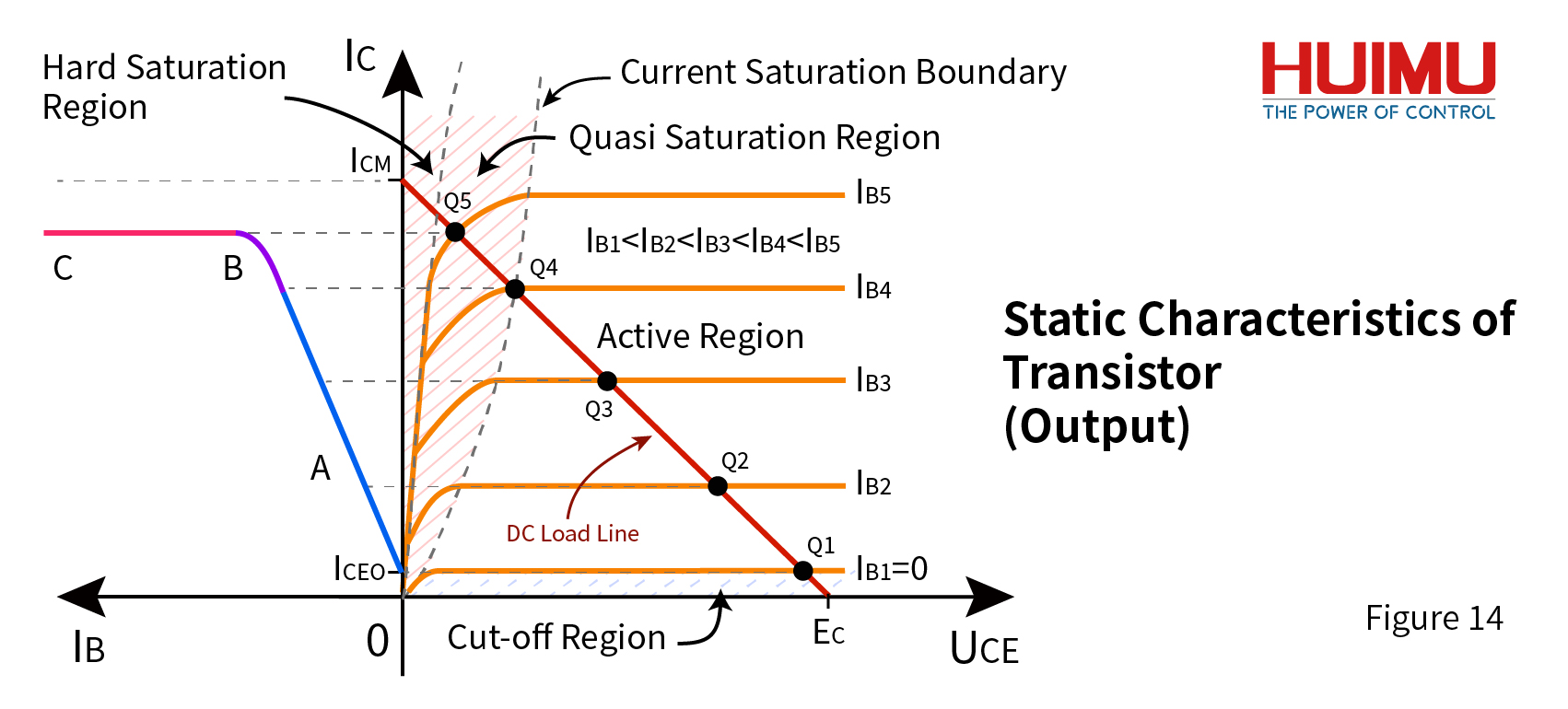
Before introducing the output characteristics of transistor, it is necessary to introduce the concept of DC load line. The DC load line is the volt-ampere characteristic curve of collector load RC (output terminal resistance) when the transistor is working in static state, IC = (EC - UCE) / RC. When the transistor enters the off state, it is equivalent to the collector circuit entering the off state. At this time, UCE=0, the voltage on RC is equal to the power supply voltage EC. When the transistor enters the on state, ICM is the possible maximum value of the output current IC, that is, the maximum current flowing through RC. Mark these two points in a rectangular coordinate system with IC as the Y axis and UCE as the X axis, and draw a line segment, that is, the DC load line. The intersection of the DC load line with the Y-axis is called the saturation point, and the intersection with the X-axis is called the cut-off point. The slope of the DC load line is the resistance value of RC.

The intersection of the DC load line and the output characteristics curve of the transistor is called the quiescent operation point, or Q point. When the transistor works at the static operating point, no matter how the AC signal in the input signal changes, the transistor can be guaranteed to work in a stable amplification state (that is, the emitter junction is forward biased, and the collector junction is reverse biased), and no nonlinear distortion will occur. When selecting the Q point, try to stay away from the saturation region (to avoid saturation distortion) and cut-off region (to avoid cut-off distortion) of the transistor to obtain the best amplification effect.

The output of Transistor

Since the transistor mainly outputs through the reverse current of the collector junction J1, its output characteristic curve is very similar to the static characteristic curve under the reverse bias of the power diode, as shown in Figure 14. Compared with power diodes, transistors have three working states. In order to understand the relationship between the output current IC and the input current IB intuitively, the X axis can be extended to the left, and the left part of the X axis can be regarded as the positive X half axis of IB. The Q points are projected to the second quadrant, which divide the characteristic curve of IC and IB into four sections: 0, A, B and C. These sections correspond to working region of the transistor.

Cut-off Region (Section 0): When UBE≤UTO or IB=0, the emitter junction is in the off state. At this time, even if the collector junction is reverse biased (UBC<0), the transistor is still in the off state (in fact, there is a very small penetration current ICEO). Similarly, if the collector junction is in the off state (IC=0), even if the emitter junction is forward biased (UBE>0), the transistor will not be turned on. Therefore, the cut-off condition of the transistor is, IC * IB = 0.

Active Region (Section A): When the emitter junction is forward biased and greater than the threshold voltage (UBE>UTO>0), IB>0, if the collector junction is reverse biased (UBC≤0), the transistor works in the active region (amplification region). At this time, the value of IC has nothing to do with UCE, but is only affected by IB, and there is a linear relationship between IB and IC, IC = β * IB.

Saturation Region (Section B and Section C): As the base current increases, the number of holes in the base region decreases, and the carriers injected into the base region from the emitter region also decreases, and the depletion layer of the base region widens. When the saturation boundary is reached, the amplification capability of the transistor begins to weaken (β' = ΔIC / ΔIB < β), IB and IC no longer have a linear relationship, and the transistor starts to enter the quasi-saturation state (shallow saturation state, Section B). When the number of holes in the base region drops to a critical value, the potential of the base region is the same as the potential of the collector region, that is, the collector junction J1 is in zero bias (UBC=0), and the base current completely loses the amplification effect (β' = ΔIC / ΔIB =0), and the transistor enters the fully saturated state (deep saturation state, Section C).

When the transistor is shallowly saturated, the base current IB is small and the conduction voltage drop is large, that is, the equivalent resistance of the transistor is large, so it is easy to exit the saturation state. When the transistor is deeply saturated, the base current IB is large and the conduction voltage drop is small, that is, the equivalent resistance of the transistor is small, and as IB increases, the saturation of the transistor will continue to deepen, so it is difficult to exit the saturation state. In actual operation, when IB(sat) = EC / (β * ICM), it can be considered that the transistor has entered the deep saturation state, which is the saturation state in the usual meaning. Sometimes in order to accelerate the transistor into the deep saturation state, a base current that is several times IB(sat) is applied. It should be noted that the working status of the transistor is also affected by the output resistance RC -- the smaller the output resistance RC, the larger the saturation current IC, and the larger the saturation voltage drop UCE, and the larger the saturation trigger current IB. As the output resistance RC decreases, the saturation current IC will approach ICM, making the transistor easily burned. If the output resistance RC is close to 0, even if the transistor is burned out, it cannot enter the saturation state. Therefore, a larger output resistance can make the transistor more likely to enter the saturation state.

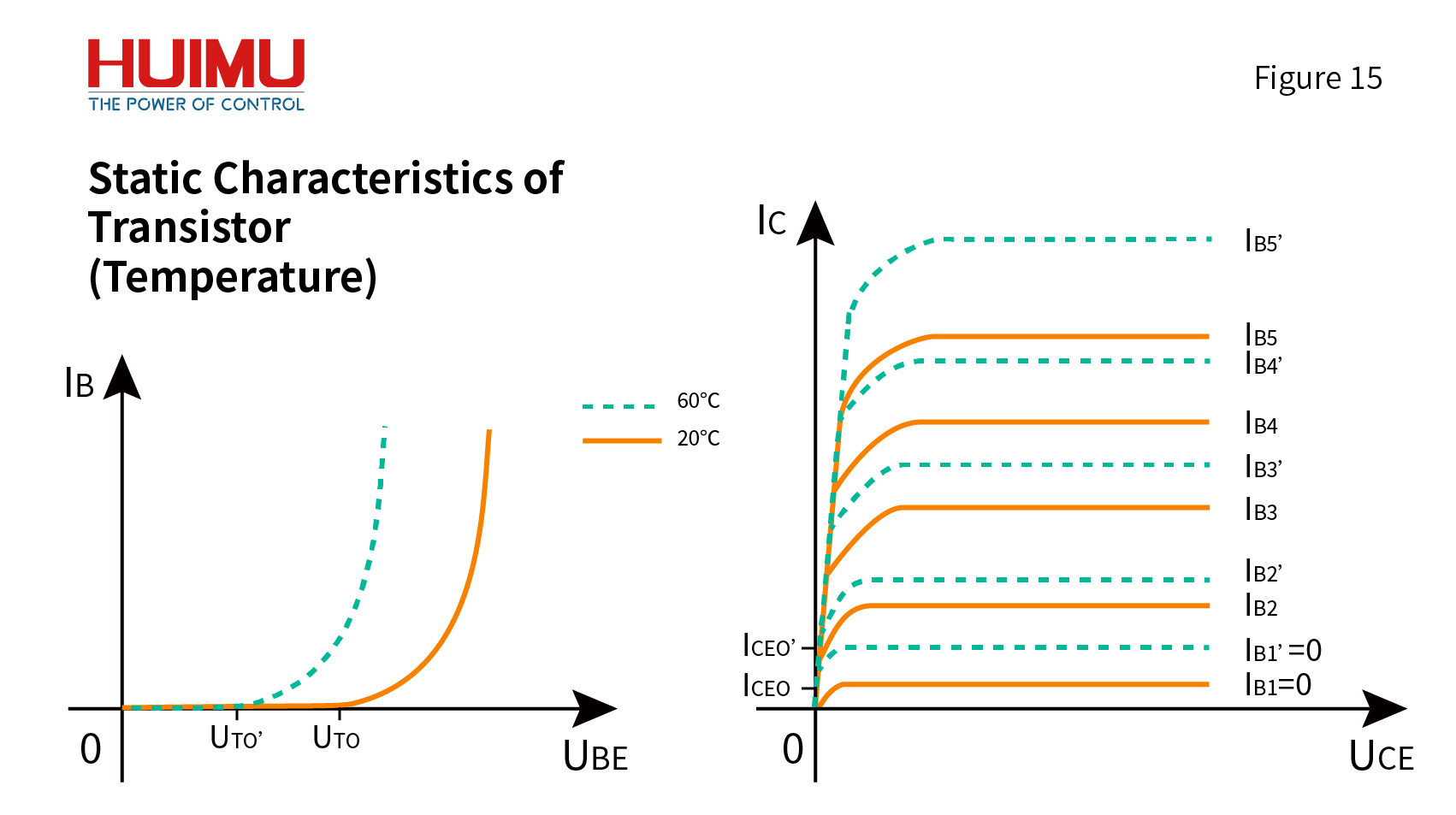
3- Temperature

The Temperature of Transistor

The increase in temperature will cause the intrinsic thermal excitation of the semiconductor, which will increase the carrier concentration inside the semiconductor and increase its conductivity. An increase in conductivity will cause an increase in leakage current, a decrease in threshold voltage, an increase in current gain and etc. Therefore, the input characteristic curve of the transistor will move to the right as the temperature rises, and the output characteristic curve of the transistor will move up as the temperature rises. The increase in temperature will also increase the possibility of the transistor thermal breakdown, so in actual use, sufficient heat dissipation conditions should be equipped to the transistor.

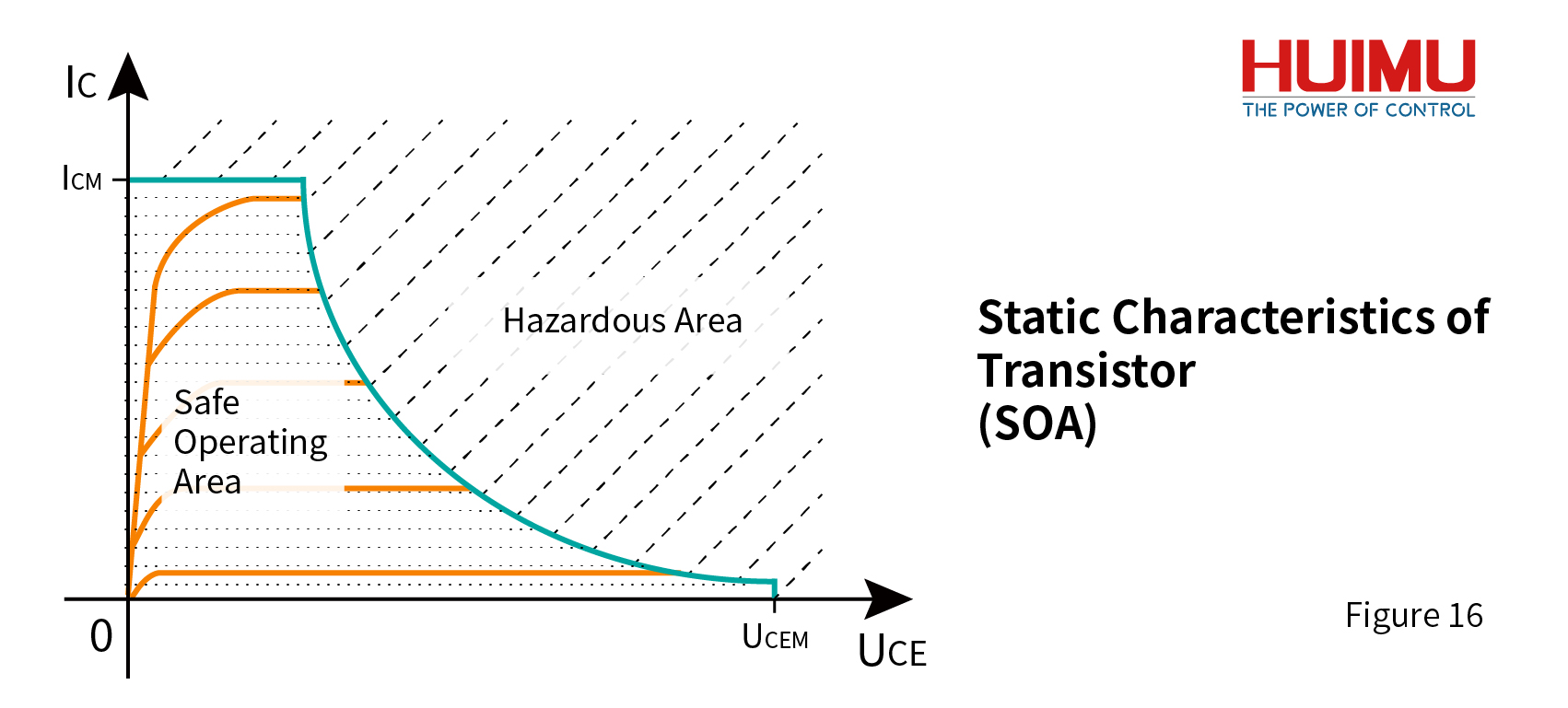
4- Safe Operating Area

The Safe Operating Area(SOA) of Transistor

If the model of a transistor is known, its PCM parameters is also known. Through PCM=IC * UCE, PCM curve can be drawn. The ICM, UCEM, PCM curves can determine the safe operating area (SOA) of the transistor, in this area, the transistor can work stably without damage. The area outside the safe operating area is a hazardous area. In the hazardous area, the temperature of the transistor will increase significantly, making it more susceptible to thermal breakdown. Therefore, the transistor should be avoided to work in hazardous areas.

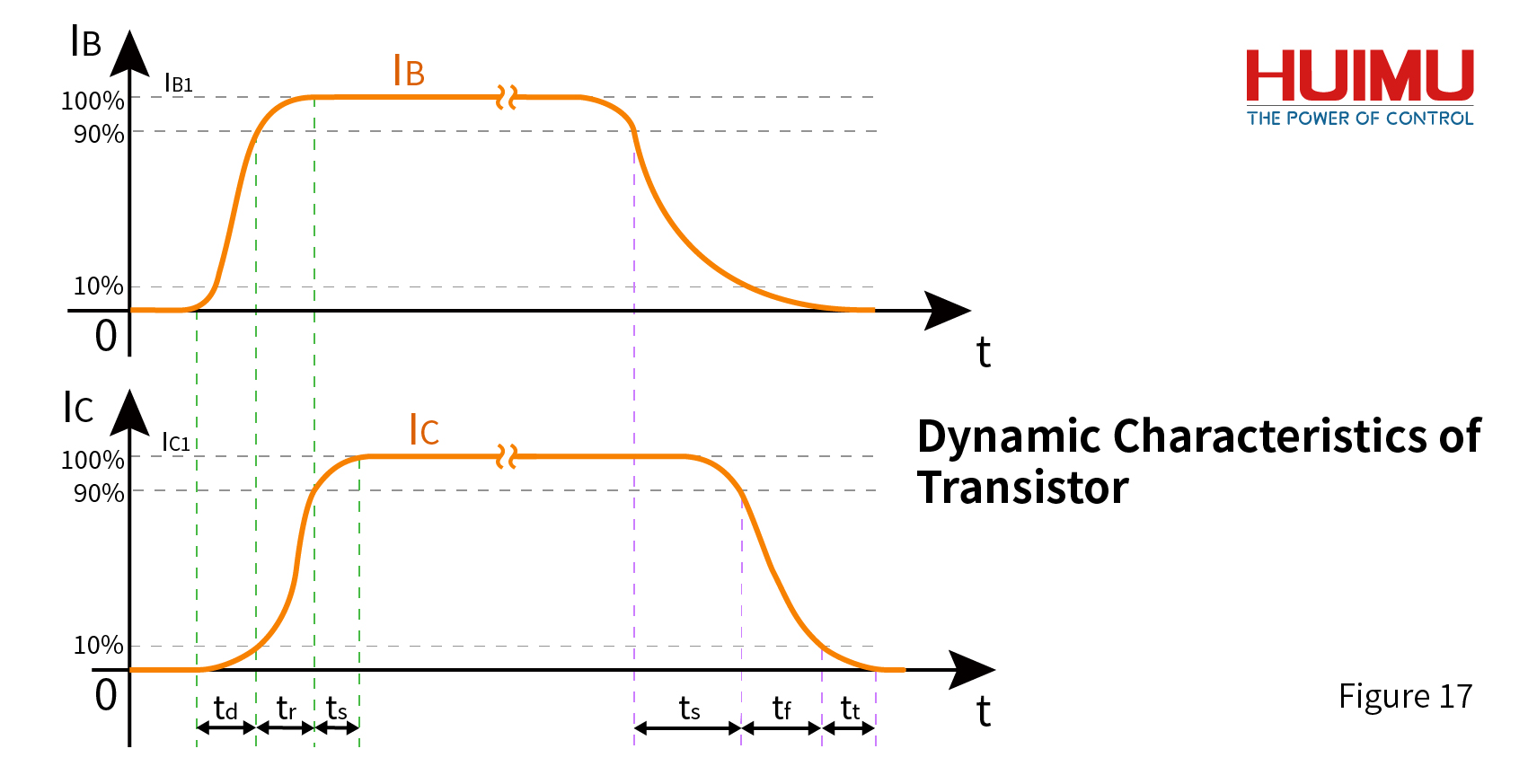
3.4.2 Dynamic Characteristics of Transistors

Dynamic Characteristics of Transistors

1- Turn-on process

When the turn-on condition (UBE> UTO) is met, the transistor will be turned on. The turn-on process of the transistor is divided into the delay time td, the rise time tr, and the diffusion time ts.

The delay time td is the time taken from 10% IB1 to 10% IC1. This time period is the time required to charge the barrier capacitor.

The rise time tr is the time taken for IC to go from 10% IC1 to 90% IC1. During this time period, IC rose sharply.

The diffusion time ts is the time taken for IC to go from 90% IC1 to 100% IC1. This time period is the time required to charge the diffusion capacitor.

The calculation formula of the turn-on time: ton=td + tr + ts

2- Turn-off process

When the cut-off condition (IB=0) is met, the transistor will be turned off. The turn-off process of the transistor is divided into the storage time ts, the fall time tf, and the tail time tt.

The storage time ts is the time taken from 90% IB1 to 90% IC1. This time period is the time required to remove the carriers stored in the base region during saturated conduction.

The fall time tf is the time taken for IC to fall from 90% IC1 to 10% IC1. During this time period, IC dropped sharply.

The tail time tt is the time taken for IC to fall from 10% IC1 to ICEO. This time period is the time required for the recombination of the remaining carriers.

The calculation formula of the turn-off time: toff = ts + tf + tt

MGR-AH_3 Series Panel Mount Solid State Relay

  MGR-AH_3 Series Panel Mount Solid State Relay [All the information on this website is for reference only, and the actual product and the a...